Heathland under a warming gradient
An interdisciplinary, long-running experiment measuring the effects of climate change on heathland ecosystem services.
- Partners
- Interdisciplinary consortium · 40+ scientists · 18+ research groupsFlanders, Brussels, Belgium + 7 European countries
- Period
- January 2020 – present
- Setup
- 6 units · +0, +1, +1.5, +2, +3, +4 °C anomaly
- Funding
- Self-financed consortium
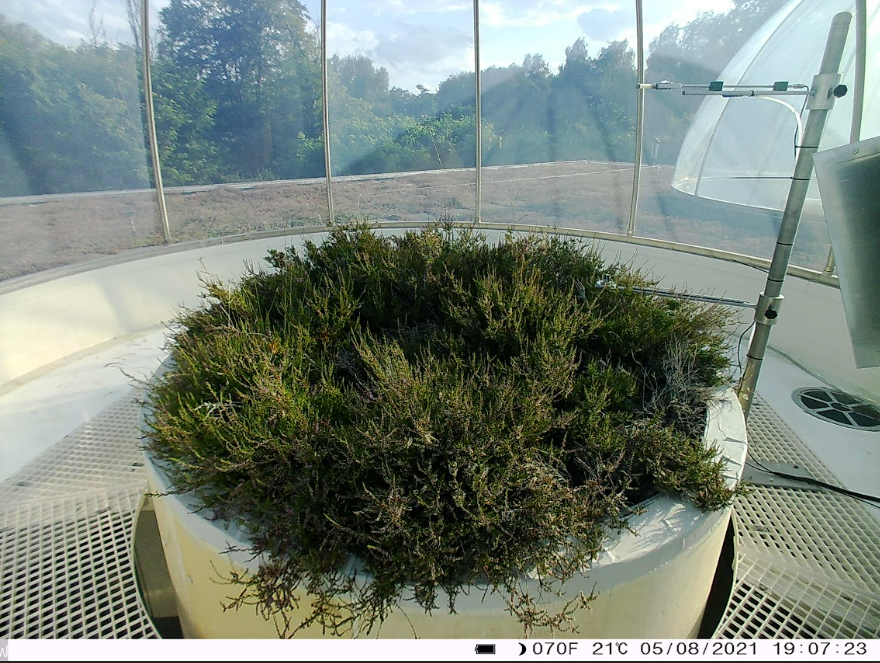
This experiment quantifies how climate change reshapes the ecosystem services delivered by heathland. It is a self-financed effort involving an interdisciplinary consortium of more than 40 scientists from more than 18 research groups across Flanders, Brussels, Belgium and seven other European countries, and has been running since January 2020.
Six ecotron units are forced along a global mean air-temperature anomaly gradient, representing a 0 °C (historical), +1 °C (present day), +1.5 °C, +2 °C, +3 °C and +4 °C warmer world.
Ecosystem response is measured in real time using the same variables as the QPEAR experiment, complemented by plant, soil-faunal and soil-microbial community composition, and full soil-biochemistry profiles.
- Evapotranspiration
- Carbon balance
- Greenhouse gas emissions
- Phenology
- Soil hydrology
- Plant, soil-faunal & microbial communities
- Soil biochemistry profiles